Industrial Metalforming Technologies

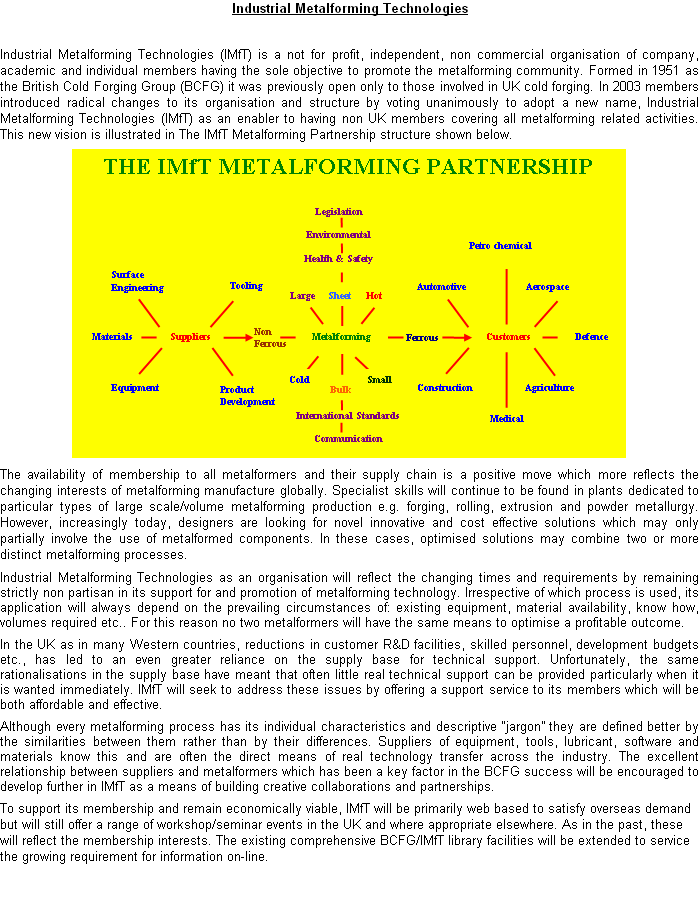
Industrial Metalforming Technologies (IMfT) is a not for profit, independent, non commercial organisation of company, academic and individual members having the sole objective to promote the metalforming community. Formed in 1951 as the British Cold Forging Group (BCFG) it was previously open only to those involved in UK cold forging. In 2003 members introduced radical changes to its organisation and structure by voting unanimously to adopt a new name, Industrial Metalforming Technologies (IMfT) as an enabler to having non UK members covering all metalforming related activities. This new vision is illustrated in The IMfT Metalforming Partnership structure shown below.

The availability of membership to all metalformers and their supply chain is a positive move which more reflects the changing interests of metalforming manufacture globally. Specialist skills will continue to be found in plants dedicated to particular types of large scale/volume metalforming production e.g. forging, rolling, extrusion and powder metallurgy. However, increasingly today, designers are looking for novel innovative and cost effective solutions which may only partially involve the use of metalformed components. In these cases, optimised solutions may combine two or more distinct metalforming processes.
Industrial Metalforming Technologies as an organisation will reflect the changing times and requirements by remaining strictly non partisan in its support for and promotion of metalforming technology. Irrespective of which process is used, its application will always depend on the prevailing circumstances of: existing equipment, material availability, know how, volumes required etc.. For this reason no two metalformers will have the same means to optimise a profitable outcome.
In the UK as in many Western countries, reductions in customer R&D facilities, skilled personnel, development budgets etc., has led to an even greater reliance on the supply base for technical support. Unfortunately, the same rationalisations in the supply base have meant that often little real technical support can be provided particularly when it is wanted immediately. IMfT will seek to address these issues by offering a support service to its members which will be both affordable and effective.
Although every metalforming process has its individual characteristics and descriptive “jargon” they are defined better by the similarities between them rather than by their differences. Suppliers of equipment, tools, lubricant, software and materials know this and are often the direct means of real technology transfer across the industry. The excellent relationship between suppliers and metalformers which has been a key factor in the BCFG success will be encouraged to develop further in IMfT as a means of building creative collaborations and partnerships.
To support its membership and remain economically viable, IMfT will be primarily web based to satisfy overseas demand but will still offer a range of workshop/seminar events in the UK and where appropriate elsewhere. As in the past, these will reflect the membership interests. The existing comprehensive BCFG/IMfT library facilities will be extended to service the growing requirement for information on-line.